Scarsdale Biology Chapter 9 Patterns of Inheritance Guided Reading Answers
Chromosomal theory of inheritance
- In 1902 and 1903, Sutton and Boveri published contained papers proposing the chromosome theory of inheritance.
- Co-ordinate to Chromosomal theory of inheritance, chromosome is the genetic material responsible for Mendelian inheritance. At that time, Mendel knew cipher of the chromosomes and meiosis.
- In lodge to explain the law of contained assortment Sutton and Boveri suggested that unlike genes were in unlike chromosomes completely independent of one another.
- This theory states that individual genes are found at specific locations on particular chromosomes, and that the beliefs of chromosomes during meiosis can explain why genes are inherited according to Mendel's laws.
- Thus, similarity between the Mendelian factors and chromosomes became apparent.
Chromosomal Theory of Inheritance supports Mendel'south police
- In somatic cell, the chromosome or factor occurs in pairs considering one chromosome is from male parent and other from mother to course homologous pair.
- During meiosis or gametogenesis, homologous chromosome pairs segregates independent of other chromosome pairs. Thus, a gamete contains only 1 particular type of chromosome ie. a gamete contains only i of ii allele of particular trait.
- The sorting of chromosomes from each homologous pair into pre-gametes appears to be random and it is similar to Mendel's law of contained assortment
- Similarly, Chromosome are transferred from i generation to some other. And the number of chromosome is fixed in each organism.
- Even though male and female gametes differ in size and morphology, they have the same number of chromosomes, suggesting equal genetic contributions from each parent.
- The gametes combine during fertilization to produce offspring with the same number of chromosome number as their parents
Morgan's experiments on Dorsophila melanogaster to explain chromosomal theory of inheritance
- In 1910, Thomas Hunt Morgan performed experiment on Drosophila melanogaster
- Dorsophila melanogaster is commonly known as a fruit fly. It has but four pair of chromosomes (3 pair of autosomes and a pair of sex chromosome). At the time of experiment, it was knew that 10 and Y chromosomes are associated with gender.
I. Cross between Red eyed female person (Xw+ Xw+) and white eyed male (Xw Y)
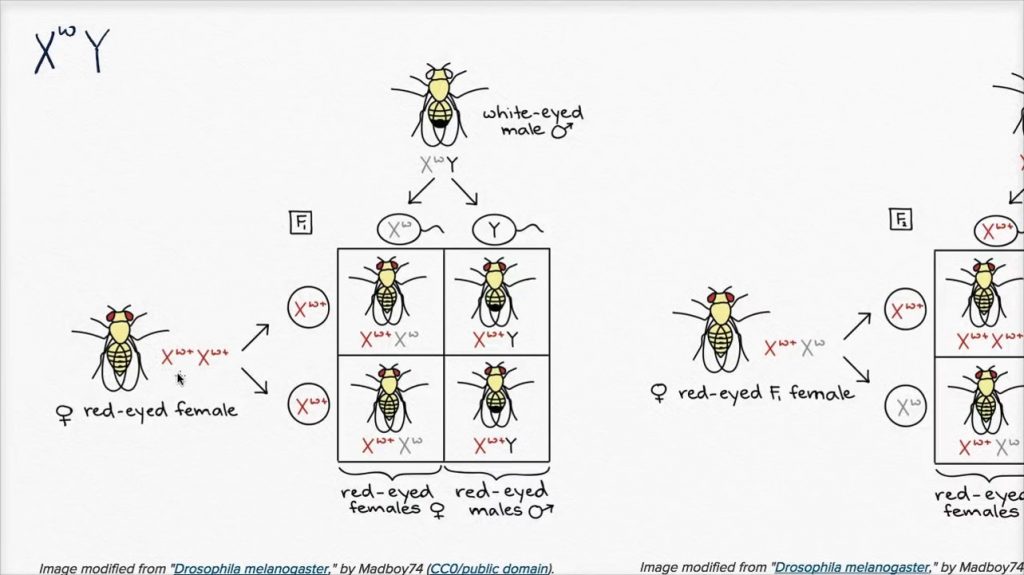
- InDrosophila, normal flies have ruby eyes and mutated flies have white eyes.
- In the experiment, normal flies with reddish eyes and mutated flies with white eyes are crossed and offspring are observed.
- Dominant allele: Red centre color.
- Recessive allele (mutated): white eye
- When a red eyed female (Xw+ Xw+) and white eyed male (Xw Y) were mated, all the progeny in F1 generation had red eyes
- Co-ordinate to Dominant and recessive inheritance design, this effect makes perfect sense.
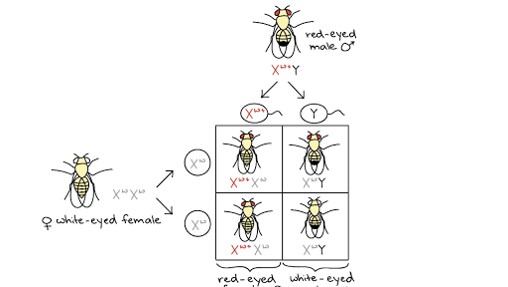
Ii. Reciprocal cross- ruddy eyed male (Xw+ Y) and white eyed female (Xw Xw)
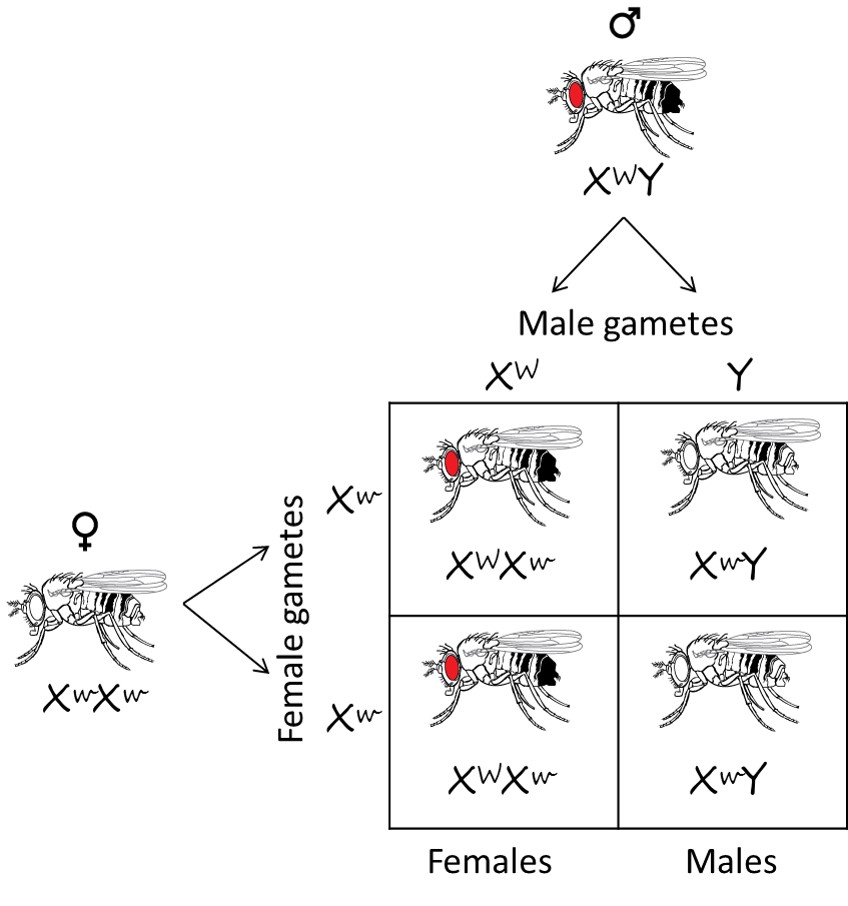
- A surprising upshot was obtained when the reciprocal cantankerous was performed past mating white eyed females to ruby-red eyed males.
- In F1 generation, instead of obtaining all the progeny with reddish eye, the issue showed that all the progeny females had red eyes and all the progeny males had white optics.
- This consequence shows traits for gender and eye color are linked, which is non accordance with Mendel'southward police of independent assortment.
- This result can be explained simply if gene for color of eye is present on X chromosome and are linked.
- Thus, this experiment on centre color of Drosophila supports the chromosome theory of inheritance. At present, all the patterns of inheritance observed by Mendel, including the principle of segregation and the principle of independent assortment can exist explained by the behavior of chromosomes during meiosis and chromosome theory of inheritance.
Annotation: Males are known equally Hemizygous considering they accept simply 1 allele for any X-linked traits. Therefore, a male with the recessive allele will always prove the recessive trait, considering he only has ane copy of the allele.
- We know, most genes are located on autosomes. This experiment of Morgan establish that gene for eye color in Drosophila is on Ten-chromosome and information technology is the commencement 10-linked trait to be identified.
Not disjunction as proof of chromosomal theory of Inheritance:
- Morgan showed that a factor for eye color was on the X chromosome of Drosophila
- I of his students, C. B. Bridges, who secured proof of the chromosome theory by showing that exceptions to the rules of inheritance could too exist explained by chromosome behavior.
- Bridges performed 1 of Morgan's experiments on a larger calibration.
- In his experiment, white-eyed female Drosophila (Xw Xw) crossed with red-eyed males (Xw+ Y) and examined many F1 progeny.
- In F1 generation, following results are obtained;
- Well-nigh all of the F1 progeny flies are either red eyed females or white eyed males which are normal
- But few flies such as white-eyed females and red-eyed males are likewise obtained which are exceptional.
- When he tried to crossed red eyed F1 progeny males with normal white eyed females, it was found that all the F1 progeny red eyed males were sterile.
- However, the F1 progeny white eyed females were fertile. When these white eyed females were crossed with normal reddish eyed males, many F2 progeny were obtained as white eyed females and ruby-red eyed males.
- It seems, the infrequent F1 progeny females produced large number of infrequent progeny in successive generation.
Caption of result:
- Bridges explained these results by proposing that the exceptional F1 flies were the result of abnormal 10 chromosome behavior during meiosis in the females of the P generation.
- Normally the Ten chromosome in females separates or disjoin during gametogenesis merely Occasionally, they might fail to separate, producing an egg with 2 X chromosomes (diplo-X) or an egg with no 10 chromosome at all (nullo-X) known as NONDISJUNCTION
- Fertilization of such abnormal eggs by normal sperm would produce zygotes with an abnormal number of sexual activity chromosomes.
- If an egg with two Ten chromosomes (XwXw) is fertilized by normal Y chromosome of sperm (Y)- the zygote volition be XwXwY. Since each of the X chromosomes in this zygote carries a mutant Xw allele, the resulting fly will have white eyes.
- If an egg without an X chromosome (O) is fertilized by an X-bearing sperm (Xw+), the zygote will be Xw+ O. (O- denotes absence of a chromosome.) Considering the single Xw+ in this zygote carries mutant Xw+ allele, the zygote will develop into a red-eyed fly
- Information technology is inferred that XXY flies were female person and that XO flies were male. The exceptional F1 white-eyed females that were observed were therefore XwXwY, and the exceptional F1 red-eyed males were Xw+O.
- Bridges confirmed the chromosome constitutions of these exceptional flies by direct cytological observation.
- Because the XO animals were male, Bridges concluded that in Drosophila the Y chromosome has nada to do with the decision of the sexual phenotype. Notwithstanding, because the XO males were always sterile, he realized that this chromosome must be important for male sexual function.
- Bridges chosen the abnomaly nondisjunctionorth considering it involved a failure of the chromosomes to disjoin during meiotic divisions.
Causes of nondisjunction:
- faulty chromosome movement
- imprecise or incomplete homologous pairing,
- centromere malfunction.
- From Bridges experiment, in F2 generation, exceptional XwXwY females produces high frequency of infrequent progeny, it means, the nondisjunction of sex chromosome goes on disjunction.
- XXY Sexual activity chromosomes can disjoin in different ways:
- Either X chromosomes can disjoin from each other form to form: X and XY
- OR X chromosome can disjoin from the Y to grade: Twenty and Y: In the latter example, a diplo- or nullo-10 egg is produced considering the X that does not disjoin from the Y is free to move to either pole during the first meiotic partition. When fertilized past normal sperm, these aberrant eggs will produce exceptional zygotes.
- These early studies with Drosophila—primarily the work of Morgan and Bridges greatly strengthened the view that all genes were located on chromosomes. Thus chromosome are the genetic material for inheritance.
Chromosomal theory of inheritance
Source: https://www.onlinebiologynotes.com/chromosomal-theory-of-inheritance/
0 Response to "Scarsdale Biology Chapter 9 Patterns of Inheritance Guided Reading Answers"
Post a Comment